


Description of mobile transformers and substations

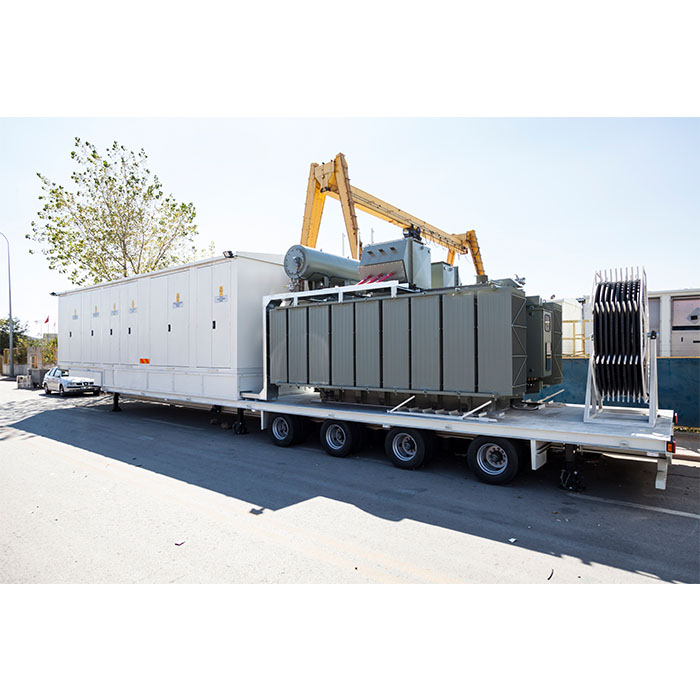
In typical stationary or fixed applications, transformers, switchgear, protection systems, and station backup power may be distributed over a large area for isolation, safety, and maintenance purposes. In contrast, the mobile system is usually self-contained and mounted on a large trailer. Figures 1 and 2 show a typical mobile substation with some of the ancillary equipment.
The units are usually mounted on moving trailers (or possibly, in some special cases, on flatbed wagons). In most cases special permits are still required to move the units due to the heavy weight. Complicating the issue are the varying state haulage load limits on local non-federal roads.
Mobile transformers are used by utilities to temporarily replace out-of-service transformers, either for maintenance or due to forced outage. Mobile transformers are more widely available in the medium power range (10 to 100 MVA) with HV ratings up to 245 kV. Large power transformers or high voltage transformers are too large to be mobile due to their physical dimensions or weight.
As described in the Standard Handbook for Electrical Engineers (Fink and Carroll, 1969), the mobile unit is designed to be a general-purpose assembly providing maximum kVA for the permitted weight. The performance and design criteria vary considerably from those of a conventional transformer. The margin between the operating voltage level of the insulation structure (BIL) and the operating voltage is generally smaller, the average temperature rise of the winding compared to the ambient temperature is generally higher, overload capability is less (if only oil/paper is used. It should be noted that for modern Nomex® or hybrid systems this is not true.), and losses and impedance tend to be higher. The mobile unit circuit is usually more complicated, in order to meet a variety of operating situations in a particular service system.
Typical characteristics of mobile transformers are shown in Tables 2 and 3. High side voltages range from 35 to 245 kV with sizes ranging from 5 MVA to 100 MVA. Transformer manufacturers’ estimates indicate that there are approximately 500-600 mobile transformers in service (just over 1% of medium power transformer inventory).
Some of these transformers are quite old but are still usable because the number of hours of use of mobile transformers is much lower than that of fixed installations.
Since mobile units operate at a higher power density than fixed units, losses are higher and therefore utilities only use them until a suitable fixed unit is obtained. According to mobile substation manufacturers, the cost is about three times the cost of the fixed transformer alone. However, this includes the trailer, switchgear, circuit breakers, standby or station power, a compact high power density transformer, and improved cooling capability.
Comparison of mobile and stationary transformers
| Mobile | Fix |
Insulation | Nomex®/Oil | Paper/Oil -Nomex® |
Temperature rise (°C) | Jusqu’à 115 | 65 |
Flux density | 1.78 | 1.5–1.75 |
Current density | 4 kA/cm2 | 0.25–0.5 kA/cm2 |
Loss assessment | Non | Oui |
Full load losses | 1.5% | <0.5% |
%Z | 12–15% | <10% |
circuit breakers | YES | Substation |
Switches | YES | Substation |
Auxiliary power | YES | Substation |
Characteristics of the mobile transformer
| LOW | NOMINAL | HIGH |
MVA assigned | 5 | 25 | 100 |
HV (kV) | 35 | 115 | 245 |
LV (kV) | 5 | 15 | 115 |
Total Weight (1000#) | 50 | 95 | 150 |

Justification for the use of mobile
Many critical infrastructures in this country rely heavily on electric power for their continued operation. Certain infrastructures, including the communications industry, public health and government services such as emergency first responders, have a crucial role to play in rapid response to outages. However, the critical infrastructure that would deal most directly with mobile transformer substation systems is the electric power industry, which owns and operates the substations where MTS systems would be used to replace lost equipment. .
The power grid is a tightly integrated network that requires precise operation of all components to deliver electricity safely and efficiently to end users. While the vast majority of outages are due to power line failures, the network is also highly vulnerable to disturbances at substations, where multiple lines intersect. Since substations are nodal points, a single outage can impact a large number of end users. There are thousands of substations across the country, and each year transformers in some of them will fail or be taken out of service. Unexpected outages can seriously disrupt the network in the surrounding territory. As noted earlier, there is usually enough redundancy in the system to withstand most single transformer failures; however, substations serving low load density areas may not have enough contingency to overcome the loss.
Mobile transformer substation systems are used for a variety of purposes within a utility. However, the losses and costs associated with these systems are usually too high for them to be used as long-term replacements. Additionally, MTS systems have lower impedance, which leads to higher fault currents, resulting in greater stress on network components such as circuit breakers. Instead, utilities use MTS systems for their primary benefit: their rapid deployment capability (approximately 12 to
24 hours). Their flexibility allows them to move from one task to another relatively easily and is in fact a primary reason for a utility to own and operate an MTS.
The potential objectives of a mobile transformer substation are as follows:
- Planned maintenance
- Temporary increase in substation capacity
- Forced Downtime Repairs
- Bad weather and other natural breakdowns Sabotage and attacks
- Planned maintenance
Planned maintenance
Mobıle transformer substation systems are used daily within the utility to provide alternate capacity during scheduled substation maintenance. Because it is desirable to have MTS systems available to emergency services during peak loads or extreme weather conditions, utilities schedule their scheduled maintenance when mobile transformer substation systems are less likely to be needed for emergency use.
Since the utility will only have a limited number of mobile transformer substation systems, substation repairs must then be staggered or delayed due to unforeseen substation transformer failures.
Temporary increases in substation capacity
Mobıle transformer substation systems may be called upon when an area may experience a temporary load increase that is not expected to last more than several months or perhaps a few years. Examples are construction projects or major plant modifications that require high electrical loads that will drop after completion. Special events may increase capacity requirements for a short time. An MTS can be used to avoid the cost of a permanent upgrade that would be rarely used. Another example is to quickly provide increased substation capacity during peak load conditions prior to substation upgrades, in the event that equipment deliveries are delayed or other issues arise. were occurring that slowed the expansion of capacity.
Forced Interrupt Repairs
One of the main areas of utility systems where MTS systems could reduce vulnerabilities is in rural medium voltage areas without redundancy. Often the grid in these areas is topologically in a radial arrangement which does not allow redundancy of parallel circuits. The loss of a substation or even a key transformer in the substation can cause major power problems downstream. The Dyersburg example described in Sect. 2.2.3 shows the social and economic impact of losing a substation in regions that do not have multiple feeds.
Unscheduled repairs may be required due to failure of existing equipment, weather phenomena, or intentional disturbances. Equipment failure is the most common reason for deployment. Lightning can cause delayed failure or accelerate the aging of critical transformer components. As transformers age, an increasing percentage of them can face sudden failure. Utilities attempt to monitor transformer conditions such as oil chemistry or load profiles to predict impending failure, but for many reasons unexpected failures can still occur.
Weather and other natural outages
Weather and natural disasters are the main cause of power outages, although these most often have a greater impact on power lines leading to substations than on the substations and transformers themselves. Certain natural disasters can adversely affect substation operations and create a need for mobile substation systems. The most likely are severe thunderstorms and tornadoes. Tornadoes are powerful enough that if they hit a substation, equipment will usually be destroyed and will need to be replaced. Floods can also cause massive damage, either by the force of the water or by short circuits and therefore damage the equipment. It is usually flooding or flying debris that causes damage during hurricanes since substations can be designed to withstand hurricane-level winds.
Sabotage and Attacks
Intentional disturbances such as sabotage could severely damage our nation’s power grid, and most substations are highly vulnerable to attack. Substations are typically unmanned, remote, exposed, and have few physical barriers. Utilities rely more on network redundancy for mitigation than on individual site hardening. Larger sites often have staff and enhanced protections, but the consequences of losing these large sites are also comparatively greater. There are few options available for replacing a destroyed high power transformer. Although there are mobile substation systems as large as 100 MVA, mobile substation systems are typically less than 50 MVA in size, with high-side voltages not exceeding 230 kV. High-power transformers, as described above, are greater than 100 MVA and can have high-side voltages of 345 kV or more and cannot currently be backed up by mobile transformer substations.
Mobile substation systems can play a crucial role in several scenarios involving deliberate attacks. The ultimate target may be critical infrastructure with limited access to electrical power via only one or two medium power substations.
If the facility is vital to the health of the region or other social needs and its substation links are destroyed, mobile transformer substation systems can be useful in getting the facility back to normal operation more quickly. This may be especially true if the attack hits multiple substations, perhaps with the intent of bringing down portions of a large urban area. The choice the utility must make is usually between mobile substations and fixed or mobile emergency generation. Even with the use of emergency generation, small mobile transformers may be called upon to adjust voltages in the area or to mitigate prolonged disturbances.
Mobile substation providing a link
crucial hose in the electrical connection
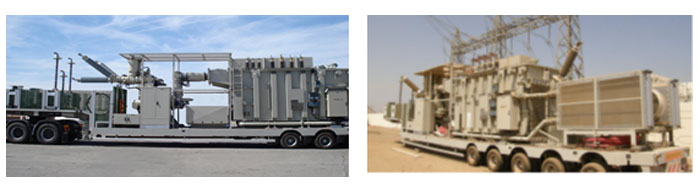
Mobile substations are stand-alone systems that offer maximum mobility and flexibility. They can be prepared, transported and operational in a very short time, making mobile substations ideal solutions to deal with a range of contingencies that utilities may face.
Substations play a crucial role in the transmission and distribution of electrical energy through the network. So what happens if a substation goes “offline”? Disruptions can be caused by a range of events beyond the control of utilities, network operators and industries, including equipment failures, natural events such as lightning, floods and earthquakes, as well as operational requirements such as maintenance and refurbishment.
mobile substations can fill the void left by these events, helping to keep the network operational and secure.
A mobile substation is a self-contained trailer or container equipped with:
- high and medium voltage components necessary for a complete substation, including a power transformer,
- switchgear and
- disconnectors (GIS, AIS or hybrid), instrument transformers, surge arresters, protection devices and control equipment, AC and DC auxiliary power supply and control systems.
Other equipment can be supplied to meet specific customer requirements.

Low Voltage Panel

Rectifier (Battery Charger)

Voltage Regulator
