


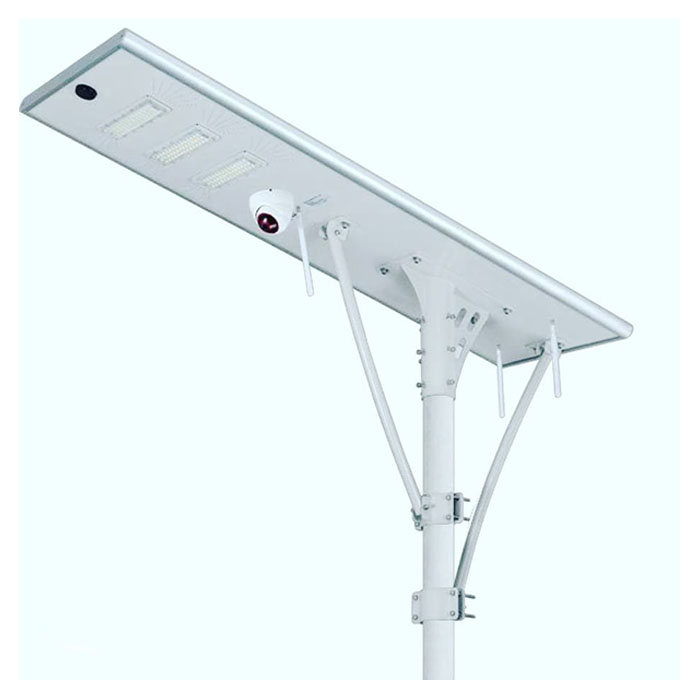
ADVANTAGES
- No electricity billing
- Quick setup
- Simple solution that requires only a small technical study
- No need to connect to the public system
- No need for expensive meters, cabinets, wiring, etc.)
- No exposed wiring and no risk of electrocution
DISADVANTAGES
- Higher purchase cost than streetlights connected to an existing public network
- Need to replace batteries every 5-10 years (depending on quality)
- Intensive maintenance: Regular cleaning of solar panels
- Risk of non-operation in the event of lack of sun
- Not recommended for shady sites (trees, valleys, etc.)
- Risk of theft of exposed installations (solar panels, batteries, regulators)
USE
- Spotlights
- Network at scattered sites (for example: roundabouts and intersections of rural roads, small public spaces)
- Sites without a public electricity network
- Site where extension of the public network is not feasible
ADVANTAGES
- No electricity billing
- Quick setup
- Simple solution that requires only a small technical study
- More economical and reliable than isolated solar street lights for medium-sized lighting networks No need for expensive meters, cabinets, wiring, etc.)
- Workable even on shady sites (trees, valleys, etc.)
DISADVANTAGES
- Higher network cost than streetlights connected to the existing public network
- Need to consult a specialist
- Need to replace batteries every 10 to 15 years (depending on quality)
- Intensive maintenance: Regular cleaning of solar panels
- Risk of interruption in case of lack of sun
- Risk of theft of exposed installations (particularly solar panels)
USE
- Small or medium-sized network on sites without a public network;
- Isolated sites with few lighting points per site (for example: small towns, isolated schools, public parks)
- Site where extension of the public network is not feasible
ADVANTAGES
- No risk of interruption in case of lack of sun
- Reasonable electricity billing (depending on the make-up of the system)
- More reliable than isolated solar systems
- Workable even on shady sites (trees, valleys, etc.)
DISDAVANTAGES
- Need for connection to the public electricity network
- Expensive solution with specialized equipment
- Need to consult a specialist
- Need to replace batteries every 10 to 15 years (depending on quality)
- Intensive maintenance: Regular cleaning of solar panels
- Risk of theft of exposed installations (particularly solar panels)
USE
- Network on sites with a public network or presence of a generator
- Safety-sensitive sites (eg main roads, municipal park of the municipality, industrial areas)
Public network (medium voltage)
ADVANTAGES
- No risk of interruption in case of lack of sun
- Low in maintenance
- No need to periodically replace expensive equipment
- Possibility of creating large networks
DISDAVANTAGES
- Very high operating costs / Regular payment of electricity bills
- Compulsory involvement of the energy company
- Risk of electrocution or fire in the event of exposed wiring near buildings (medium voltage network)
USE
- Medium and large-scale network provided with a public electricity network (for example: main towns, industrial areas)
- Sensitive sites report security
Public lighting network equipment
Basic equipment
The public lighting network is mainly composed of:
- electrical cabinets or cabinets used to control and protect the network
- electrical cables used to transport electricity from power sources
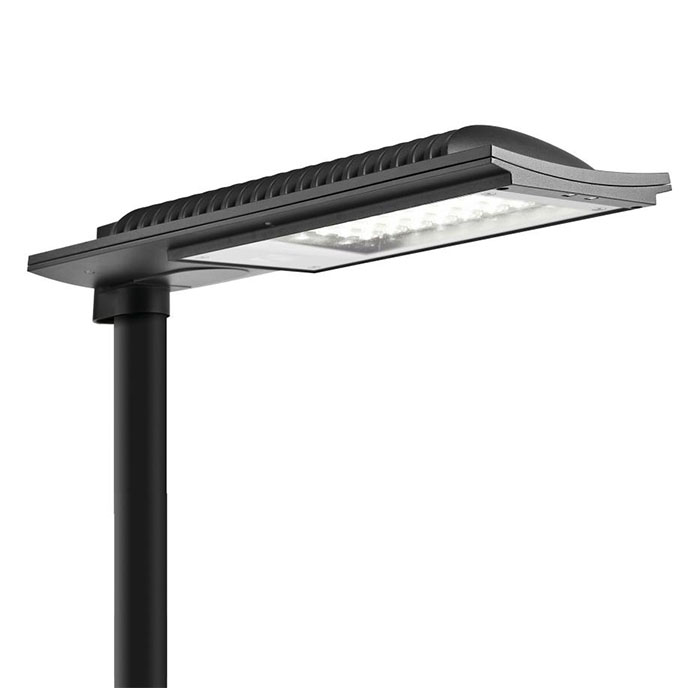
- light points / streetlights that illuminate the public space
- the connection wiring
Also called Control and protection box (CCP), the public lighting cabinet allows the supply of the public lighting network from the public energy distribution network. It contains metering, control and protection equipment or devices. A cabinet is generally made up of a part for metering electricity consumption, a part for switching on light points containing components such as twilight sensors or clocks and contactors, comprising all the protection devices (circuit breaker, fuses…).
The type and size of the cables depend on the voltage of the lighting network (low voltage, medium voltage), the distances to be served, the location (underground or exposed), the protection (placed in sheaths or armored cables) . The way of laying the cables and the type of cables have a significant impact on the costs of the lighting network.

Cabling laying principles
There are two main types of networks in public lighting: The independent network in underground cables which is the most recommended, because it is secure and offers more appropriate lighting and the mixed network on poles and on facade with cables exposed or partially exposed (air network). The latter continues to represent a certain percentage of the public lighting network, part of which is on the facade, and this solution is usually less expensive. However, public lighting on an overhead network does not provide lighting that complies with the standards in force. Indeed, the inter-distance between supports is imposed by the distribution network serving the dwellings and not according to lighting requirements.

Light Point,
The light point is one of the most important and sensitive parts of the public lighting network. Indeed, it is the part which carries the light source and which is the most exposed to breakdowns and hazards. It requires special attention, both in terms of design and maintenance. A light point is essentially composed of a luminaire, a bracket and a mast with a junction box. The complete solar street lights also house the PV module, the battery and the controller with twilight sensor.

Parts of a floor lamp
Lantern
Element also called lantern or lighting device, it is composed of an envelope comprising:
- Bowl: Element that protects the lamp and the reflector from the outside environment, it is made of glass or plastic and diffuses the light emitted by the source.
- Optic or reflector: Element shaping the light emitted by the sources, so as to adapt the lighting to the track while limiting light pollution. The two main families being symmetrical or circular optics suitable for lighting squares or parking lots and asymmetrical or road optics favoring lighting in front and on the sides.
- The luminaire, i.e. the lamp or light source
Lamp or light source
Element producing light, the main families being discharge lamps (fluorescent balloons, high pressure sodium, metal halide, etc.), filament lamps (halogen, incandescent) and semiconductors (LED module).
Two types of lamps are favorable for public lighting networks, thanks to their power, their low electricity consumption, their efficiency and their longevity: High-pressure sodium lamps and LEDs.
LED technology has several advantageous characteristics and is of great interest for the public lighting manager wishing to optimize and develop the public lighting service. Indeed, the main advantages of LED are:
– Lifespan: More than 50000 hours
– Luminous efficiency: up to 130 lumen/watt (luminaire efficiency)
– Compatibility with direct current: direct power supply by solar source
– Energy saving: 50% replacing high pressure sodium lamps, 80% replacing high pressure mercury lamps
– Comfort and safety: improved lighting uniformity
– Good color rendering: much better than high pressure sodium lamps
– Instant light: no heating or cooling time
– Easy and less expensive maintenance
– Flexible lighting: possibility of varying intensities on several levels
– Wireless management of luminaires individually or in groups
– Dynamic lighting allowing light effects for animation. LED lighting can produce millions of colors thanks to the mixture of basic colors red, blue and green.
Ballast
Discharge lamps require a ballast. It is advisable to use electronic ballasts with low consumption and long life.
Stock
Most often metallic element allowing the lantern to be offset. Often the stock is attached to the mast through height-adjustable collars.
Mast or support
Element supporting the luminaire, sometimes accompanied by a bracket. It can be straight or slanted. Ideally, the mast is fixed to the concrete footing through a metal plate to facilitate its replacement, if necessary.
Depending on the function, the aesthetic aspect, the space and the environment, one can identify several types of supports, for example a post made of steel, aluminium, cast iron, concrete, wood and of tubular shape, cylindrical- conical, octagonal with or without base, a decorative mast, a catenary, a traditional candelabra, a console on the facade; it can be embedded in the ground, etc.
Automatic switch-on and switch-off management equipment
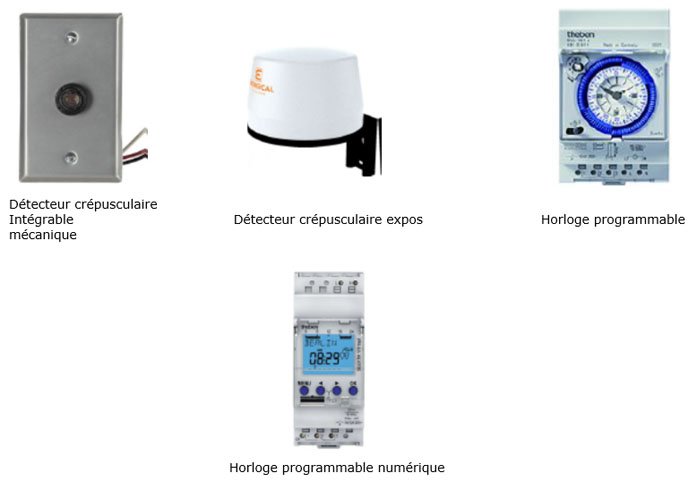
Public lighting in external spaces is only necessary for the duration of the lack of natural light. Two appropriate technologies exist for the automatic management of public lighting, and they are required (decree 2006-432): Twilight sensors and time switch (clock)
Twilight sensors
with a photocell. They are either integrated into the equipment (e.g. a controller) or they are stand-alone units. Lighting controlled by a twilight switch automatically switches the public lighting off and on according to daylight.
To ensure the reliability and accuracy of the switch, it is essential to position and orient the sensor correctly so that it is not affected by random light sources or disturbed by shadows. It must also be checked and cleaned regularly to prevent the accumulation of dust. The twilight switches can be associated with clocks in order to cut off the control for part of the night.
Programmable time switches
preferably of the so-called astronomical, digital or mechanical clock type. They are normally integrated in control boxes. This type of clock controls the switching off and on of public lighting at specific times. They are installed in public lighting cabinets. If it is not an astronomical clock, it must be adjusted and updated regularly in order to approximately follow the times of sunrise and sunset.

Low Voltage Panel

Rectifier (Battery Charger)

Voltage Regulator
